A Vision in Punta Rica
Colombia's Eje Cafetero
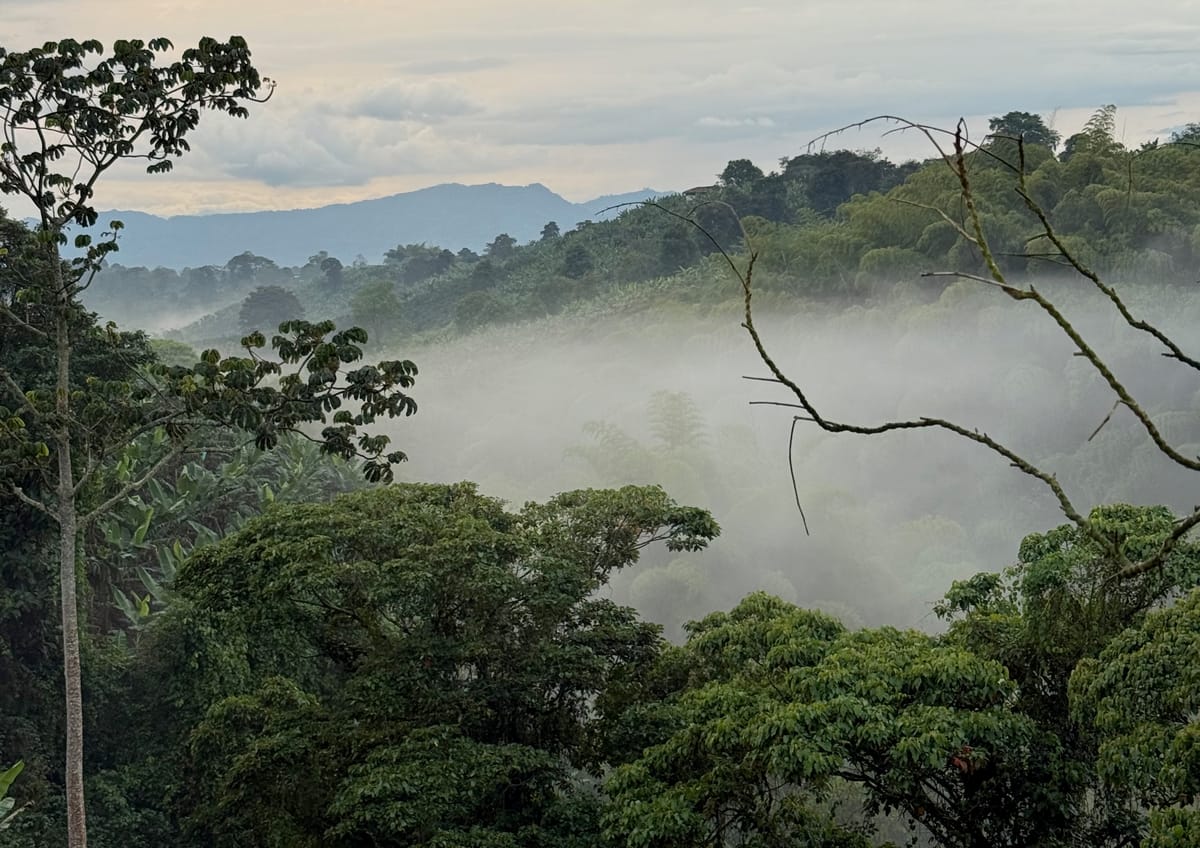
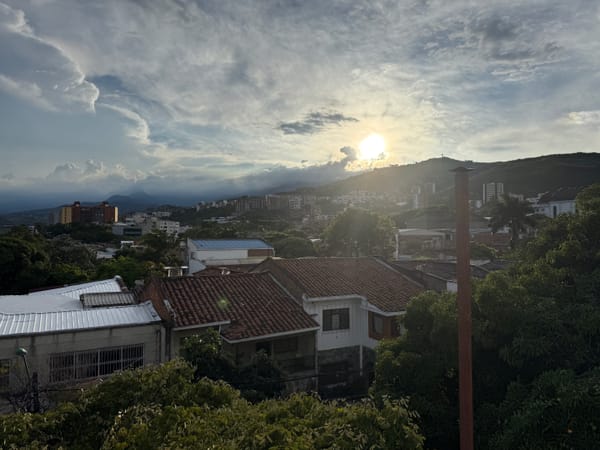
I am currently working at a hostel/coffee farm in the Eje Cafetero, the Colombian coffee axis. Our finca is situated between Quimbaya and Filandia, with thick semi-tropical vegetation covering the hills.
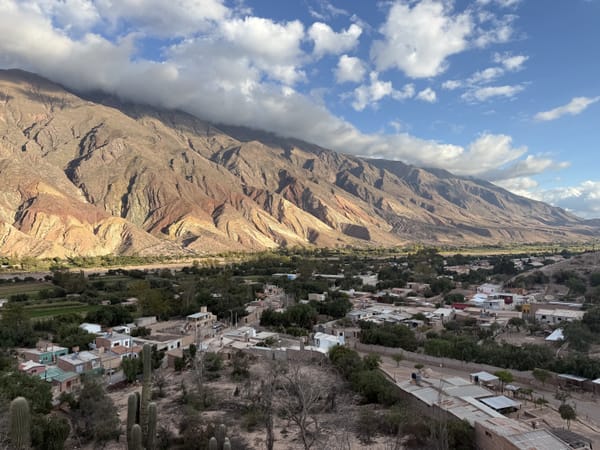
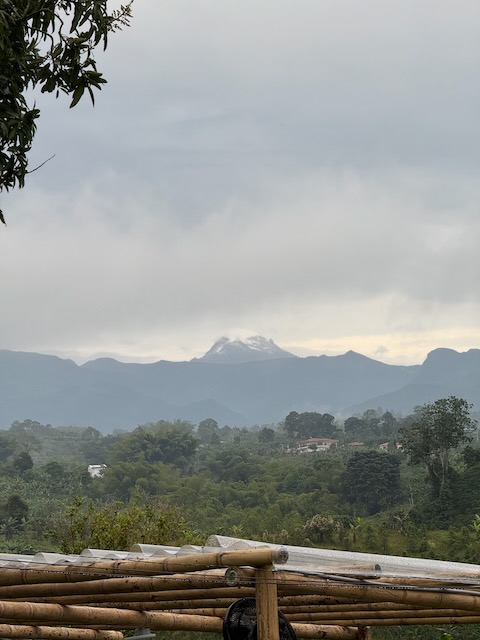
The weather here is weird. Cloudy, sunny, rainy, hot–all in the same day. When it clears up, you can see the Nevada Tolima, a 5000m snow-covered peak of the Andes.
Willys
The hostel is off a dirt road, 40 minutes by Willys from the nearest town. Willys, AKA jeeps taxis, are the default mode of transport around here.
After World War 2, the US was sitting on a massive surplus of jeeps, and started offering them to Colombian coffee farmers at cheap prices. The archetypical Willys flies the Colombian flag and sports Jesus’s face on the stickshift. They have become something new and uniquely Colombian—a symbol of the region.
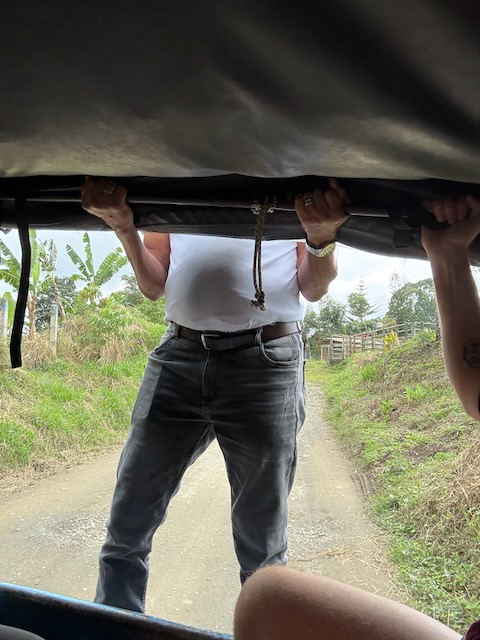
These jeeps have been retrofitted to haul as many people and goods as possible. They call them “burros mecánicos”—mechanical mules. Each Willys has a metal cage in the back with two short benches. At full capacity, I’ve heard of 36 people on one jeep, with 8 people standing on the tailgate.
There are no safety mechanisms whatsoever. When standing, you grip the cage with all your strength as you bounce over potholes and whip up mountain curves. Yesterday, as I stood on the tailgate, I felt my body veering past the edge of the chassis and my sweaty palms began to lose grip. I thought this might be the end. Then, I looked up and a 5-year old Colombian kid was just laughing in my face.
Most days in the back of the Willys, it’s an assortment of locals–a mom returning from shopping, a carwasher coming home from a 12 hour day, an 80-year old plantation owner headed over to check his operation. When someone gets off, everyone wishes them well. “¡Que le vaya bien!”—”Have a good one!”
Work
I am working as a waiter and social host in the evenings, running games of charades for an international crowd. Many of the guests are French, as the hostel is run by a Frenchman with a shaved head and a Parisian swagger.
The other volunteers are all from Argentina. Two girls are a couple, and maybe aren’t the friendliest people on this Earth. The older one wears Converse every day, a rotating cast of punk band T-shirts, and has harsh-cut straight bangs with Skrillex shaved sides. Her girlfriend sports a blonde soft mullet which she covers with a bandana, giving her a sort of Rosie the Riveter look. She occasionally smiles and doesn’t treat me like a complete idiot, which I appreciate.
I have tried to strike up conversations with them on several occasions, but usually, I am stonewalled with one word answers. In Spanish, my small talk capabilities are about a 3 out of 10. Once I asked if they’d studied any English in school; they said they don’t like English because it’s the language of the colonizer and they try to avoid places where gringos go.
I must be the devil incarnate to them. Hi, my name is Michael. I am a white, straight, American, English-speaking male. Where’s my bed?
My other roommate is great. She’s also Argentinian, but she’s friendly. We’ve bonded over language learning, as she’s learning English and I’m learning Spanish. She told me my Spanish gives her “ternura”—the feeling when you see a baby or a puppy.
I’m not a great waiter. I take people’s orders, ask their names, and immediately forget everything I’ve just heard. My middling Spanish, which might seem “cute” in certain contexts, seems to get on the Argentine couple’s nerves when we have 25 guests waiting on their plates to be served and I don’t understand what they’re saying, because they speak in rapid fire jabs of Argentine. Vos, Chhhho, No entendés?
Our chef, Juan Pablo, is my favorite. He must have smoked thousands of cigarettes in a past life to produce his gravelly singsong voice. In between boiling pots of Sancocho, he warmly offers me some dick pills from his personal stash, and advises that “the cariñosas only come on Friday night.” But more often, he just stands next to me, holding my earlobe, muttering to himself, “papi, tan bello, tan bello,” while he stares into the distance.
Punta Rica
We had a big staff night out last Friday. We met in Quimbaya, the nearby town where most of them live. We had our own table and several bottles of aguardiente being passed around at Punta Rica, which was maybe the loudest bar I’ve ever been in.
I introduced myself to one of the dudes in the booth. I could barely hear him over the deafening reggaeton, but it sounded like he said his name was “John.” So I told him, “It’s ok, I know your name is really Juan. I’m gonna call you Juan!” He insisted a few times that his name was John, but seeing as that didn’t make sense, I told him that wasn’t his name.
Around 1am, we decided to leave. An aguacero had begun, and it was pissing down rain. We assembled under the awning, then suddenly Juan was swinging at some random guy in the street. Unfazed, the group cheered and waited for him to finish. Then, we all set off into the rain.
I remember about 12 of us packed into a Willys with the rain hammering on the canvas roof. Three people stood on the tailgate in the back. There was a big flash of lightning and I saw a crouching figure on the tailgate, smiling in the rain, dressed like a skinny Colombian Fat Joe, covered in tats and gold chains and a flat brim hat.
The next morning I woke to a follow on Instagram from @JhonFredy.
The jeep we rode in that night was made in the US in 1955; it has carried generations of passengers through the rain and the sun and the mud from Filandia to Quimbaya and beyond. It’s shuttled plantation owners and carwashers, schoolkids and their parents, piles of fruit and sacks of coffee. I bet it never could have imagined—from some distant factory in the States—the lightning flashing, the rain hammering on the canvas roof, and the shouts from the twelve of us on the way home from Punta Rica.